

BHOJSONS Group Delivers PIAGGIO Tricycle Ambulances to Katsina State —
Leadership with a Heart
Thank You, Your Excellency Dr. Dikko Umar Radda, for Championing a Life-Saving Cause.
Katsina, Nigeria — September 15, 2026
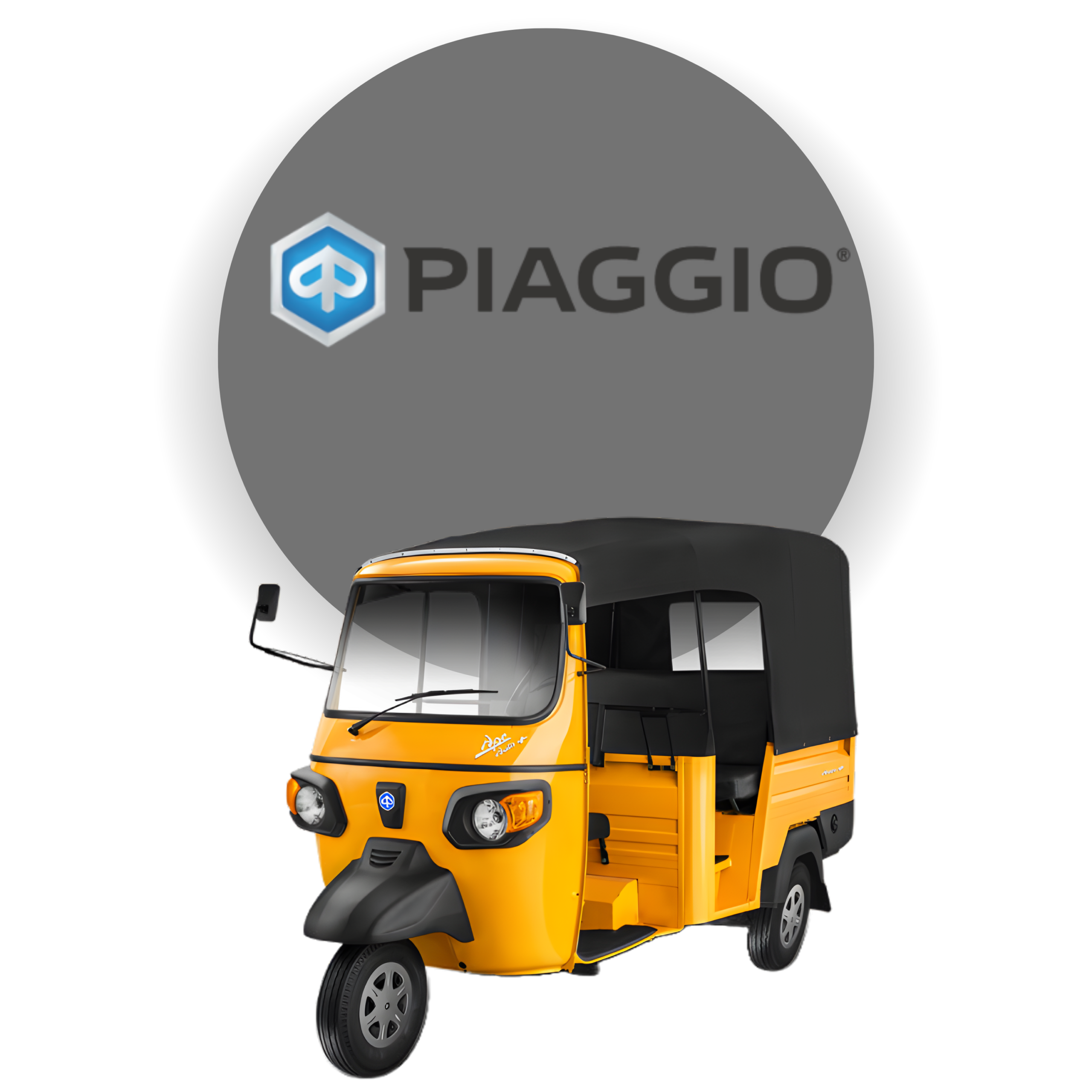
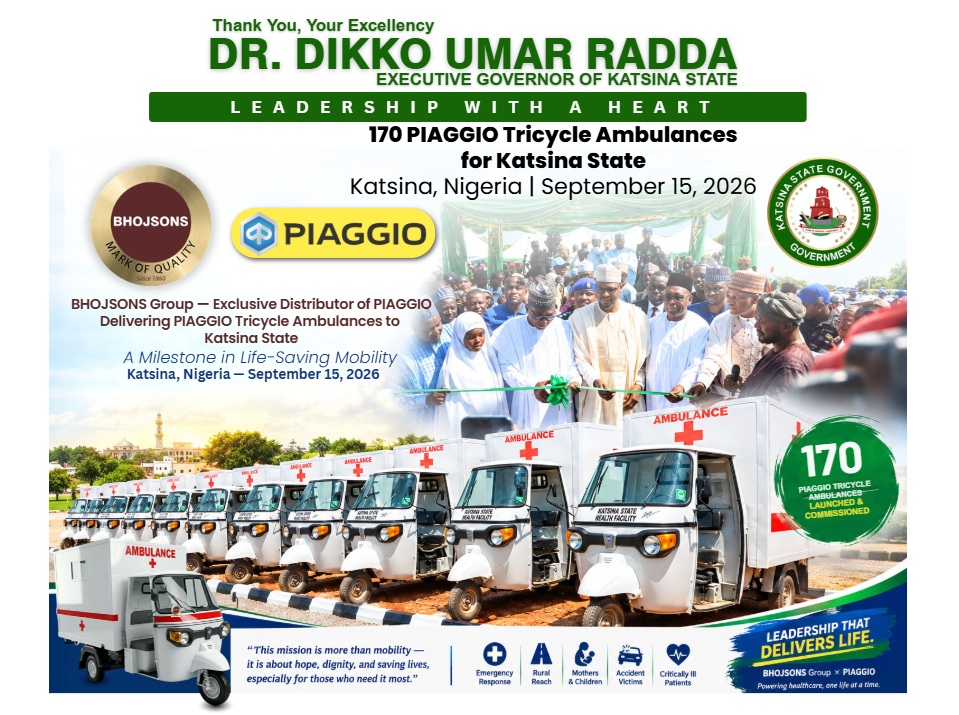
In a landmark event for healthcare delivery in Northern Nigeria, the Katsina State Government, through the Ministry of Health, officially launched 170 PIAGGIO Tricycle Ambulances and commissioned key health facilities across the state — a bold step toward bringing urgent medical care to the doorsteps of every community.
The historic ceremony was inaugurated under the leadership of His Excellency, Dr. Dikko Umar Radda (Gwagwaren Katsina), Executive Governor of Katsina State, and performed by Prof. Muhammad Ali Pate, Honourable Coordinating Minister of Health, Federal Ministry of Health and Social Welfare, at Koda Health Clinic, Koda Town, Charanchi LGA.
Driving this transformative initiative from vision to reality is BHOJSONS Group — one of Nigeria’s foremost mobility and power solutions companies, and the trusted and EXCLUSIVE partner behind the delivery of over 170 PIAGGIO tricycles as life-support ambulances to Katsina’s medical facilities. As the proud home of EXCLUSIVELY DISTRIBUTED & globally respected brands including PIAGGIO, the world-renowned Italian manufacturer, BHOJSONS Group supplied these purpose-built medical response vehicles: rugged, reliable, and accessible emergency units capable of navigating rural roads and reaching patients where conventional ambulances cannot.
What sets BHOJSONS Group apart is not just delivery — it is dependability. With a robust sales, service, and spare-parts network spanning across-Nigeria, BHOJSONS Group ensures that every tricycle on the road remains mission-ready, with dedicated after-sales support, warranty and technical expertise available across the country. For healthcare providers, this means one assurance: help never breaks down.
“This mission is more than mobility — it is about hope, dignity, and saving lives, especially for those who need it most.”
Each PIAGGIO tricycle ambulance delivered EXCLUSIVELY by BHOJSONS Group is engineered to carry patients safely with medical support equipment onboard, serving as a vital first-response link between remote communities and health centers — protecting mothers in labour, accident victims, and critically ill patients across Katsina State.
Under the leadership of Dr. Dikko Umar Radda (Gwagwaren Katsina), Executive Governor of Katsina State, this initiative reflects a strong commitment to strengthening access to essential healthcare and ensuring that life-saving services reach communities across the state.
BHOJSONS Group is proud to stand alongside the Katsina State Government and the Federal Ministry of Health in a partnership in service of humanity — a vision that truly puts people first, and a commitment the company continues to deliver across Nigeria.
With the continued support and vision of His Excellency, Dr. Dikko Umar Radda (Gwagwaren Katsina), Executive Governor of Katsina State, the initiative marks another meaningful step toward bringing healthcare closer to the people.
Leadership that delivers life. BHOJSONS Group × PIAGGIO — powering healthcare, one life at a time.
The Nigerian Emergency: A Race Most People Lose
Consider what happens when a medical emergency strikes in much of Nigeria. A woman goes into obstructed labour in a village. A child spikes a dangerous fever at 2 a.m. A farmer is injured on a rural road. A stroke begins its silent, clock-ticking damage. In each case, survival depends on one thing above all: reaching skilled care fast. And in each case, the odds are stacked against them.
The data is sobering. A 2026 report found that only about 7% of medical emergencies in Nigeria are handled by public ambulances [The Guardian, 2026]. While Lagos records an average emergency response time of around 17 minutes — already more than double the World Health Organization’s 8-minute benchmark — delays in rural Nigeria can stretch beyond two hours [The Guardian, 2026]. In one narrative review, ambulances were found to convey as little as 5.4% of certain critical patients; the rest arrived by private car, commercial bus, on foot, or — in the absence of anything else — by keke [Out of Hospital Emergency Care in Nigeria, 2023].
The consequence is measured in lives. That same reporting estimates that 10 to 15% of Nigeria’s 1.6 million annual deaths occur within emergency departments — largely because patients arrive too late, or without any stabilising care on the way [The Guardian, 2026]. The tragedy is rarely a lack of medicine. It is a lack of time, and a lack of a way to get there.
The Second Delay: Where Lives Are Quietly Lost
Global health has a name for this. The “Three Delays” model, used by the World Health Organization to understand preventable maternal deaths, identifies three points where the system fails: the delay in deciding to seek care, the delay in reaching a facility, and the delay in receiving care once there [WHO, Emergency Obstetric and Newborn Care].
It is the second delay — reaching care — that quietly claims so many Nigerian lives. And it is overwhelmingly a transport problem. Research shows maternal mortality rises dramatically when a woman lives more than 5 kilometres from a health facility [Nexus Engineering, 2025]. A 2025 study on healthcare access found that 30% of Nigerians experienced delays in seeking care because of transport challenges, and 72% named transport cost as a major obstacle [African Health Report, 2026]. Vehicles are scarce, especially at night; roads are poor; and families are too often forced to choose between transport fare and food [African Health Report, 2026].
This is the exact gap a tricycle ambulance is built to close. Not the high-tech gap of the intensive-care unit — but the far deadlier, far more common gap between a sick person and the road to help.
Why a Tricycle, and Why It Changes Everything
Here is the insight at the heart of the Katsina initiative: the vehicle best suited to Nigeria’s emergency-access crisis is not always the biggest or most expensive one. It is the one that can actually get there.
A conventional ambulance is a marvel — but it is also large, costly to buy and run, and frequently useless on the very roads where emergencies are deadliest: the narrow village lanes, the unpaved tracks, the tight, congested neighbourhoods where a full-sized vehicle simply cannot pass. A fleet of a few big ambulances covering a whole state leaves vast rural stretches effectively uncovered. This is why so much of Nigeria’s ambulance hardware, where it exists at all, still fails to reach people in time — the problem, as one report put it, is in the “connective tissue,” not just the hardware [The Guardian, 2026].
The Piaggio tricycle ambulance rewrites that maths. It is rugged and reliable, able to navigate rural roads and reach patients where conventional ambulances cannot. It is affordable enough to deploy not in ones and twos, but in fleets of 170 — putting a response vehicle within genuine reach of communities that never had one. Each unit is engineered to carry patients safely with medical support equipment onboard, serving as a vital first-response link between remote communities and health centres — protecting mothers in labour, accident victims, and critically ill patients across the state. It does not replace the advanced ambulance. It does something arguably more urgent: it closes the first, fatal gap, and it does so at scale.
More Than a Keke: The Three-Wheeler Reimagined
For years, the tricycle has been one of Nigeria’s great economic workhorses — the keke that carries passengers, moves goods, and turns a modest investment into a daily livelihood. The Katsina deployment reveals something more: the same versatile platform that powers commerce can also save a life.
This is the quiet genius of the three-wheeler. Its compact size, low running cost, manoeuvrability and ruggedness — the very qualities that make it the king of the last mile in logistics — make it equally powerful as a first-response medical vehicle. Configured as an ambulance, it becomes a mobile bridge to care. Configured for cargo, it moves goods. Configured for passengers, it moves people and income. One platform, many missions — and now, one of those missions is saving lives.
That multipurpose strength is exactly why Piaggio, backed by Bhojsons Group, represents such a compelling opportunity — not only for governments, but for the private sector that serves them.
A Call to Distributors, Wholesalers and Investors
The Katsina milestone is not an endpoint. It is a proof of concept — and a signal to the market. Across Nigeria’s 36 states, the emergency-access gap documented in the data above is a nationwide reality. Every state, every local government, every large rural community faces some version of the same second delay. The demand for affordable, deployable, rugged medical-transport solutions is enormous, growing, and largely unmet.
For distributors, wholesalers and investors, this is a rare convergence: a product that serves a critical social need and a substantial commercial opportunity. Government health ministries, development partners, NGOs, faith-based hospitals, private clinics and community health schemes all represent live markets for tricycle ambulances and the broader Piaggio range. Partnering with Bhojsons Group means aligning with the exclusive, trusted mobility partner that just delivered one of Northern Nigeria’s most significant healthcare-mobility projects — with the manufacturing pedigree of Piaggio and the nationwide distribution, financing and after-sales backbone of a group Nigeria has trusted since 1860.
To invest in these vehicles is to invest in something with a double return: a business that grows, and a community that lives. In a market where social impact and commercial opportunity so rarely align this cleanly, the tricycle ambulance is a category worth building a business around.
Leadership That Delivers Life
What happened in Katsina is a model for what public-private partnership can achieve when it puts people first. A government with the vision to see that access — not just facilities — is the frontier of healthcare. A federal ministry lending its weight. And a private-sector partner able to turn that vision into 170 vehicles on the ground, ready to move.
Through Piaggio, supplied and backed by Bhojsons Group, the humble three-wheeler has been given a new and profound purpose: to stand between a Nigerian in crisis and the care that can save them. It will not solve every gap in the health system. But it will close the one that quietly kills the most — the gap of distance, of time, of a way to get there.
Because when every minute is a life, the most important ambulance is the one that actually arrives.
To partner with Bhojsons Group on Piaggio tricycle ambulances and the wider Piaggio range — as a government, institution, distributor, or investor — visit bhojsonsgroup.com or contact your nearest Bhojsons branch. Bhojsons Group × Piaggio: powering healthcare, one life at a time.
References
- The Guardian Nigeria. (2026). Only 7% of Emergencies Handled by Public Ambulances — Report. https://guardian.ng/features/health/only-7-of-emergencies-handled-by-public-ambulances-report/
- World Health Organization. Emergency Obstetric and Newborn Care & the Three Delays framework — cited in Nigeria Health Watch (2026). https://nigeriahealthwatch.com/articles/thought-leadership/beyond-the-numbers-what-data-and-community-voices-reveal-about-maternal-deaths-in-nigeria/
- African Health Report. (2026). When Distance Decides Survival: Nigeria’s Hidden Healthcare Access Crisis. https://africanhealthreport.com/distance-decides-survival-nigeria-healthcare-access/
- Nexus Engineering & Planning Ltd. (2025). Mapping Nigeria’s Health Infrastructure. https://nexuseng.org/insights/30daymapchallenge-day1-points-health-facilities/
- Out of Hospital Emergency Care in Nigeria: A Narrative Review. (2023). PMC. https://pmc.ncbi.nlm.nih.gov/articles/PMC10331399/
- World Health Organization. (2025). Trends in Maternal Mortality — cited in CHELD. https://cheld.org/maternal-health-in-nigeria/
📞 070024657667 | 🌐 www.bhojsonsgroup.com | @bhojsonsgroup